Barka da zuwa CucurbitAgent
Dandamali mai hankali na zamani don binciken Cucurbitaceae, wanda ke haɗa manyan samfuran harshe (LLM) da bayanan oga-nyingi (multi-omics).
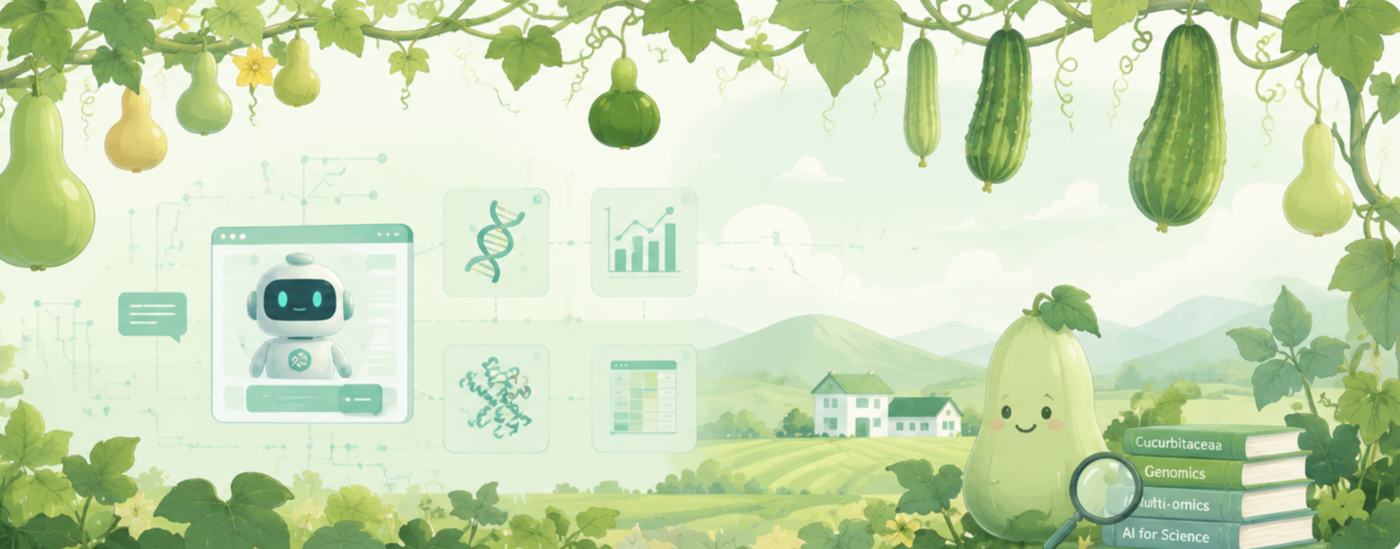
Game da CucurbitAgent
Iyalin gourd (cucurbits) —kankana ruwa (watermelon), gyaɗa (cucumber), kankana zaki (melon), kabewa (pumpkin), goro mai ɗaci (bitter gourd) da sauran amfanin gona masu alaƙa— amfanin gona ne masu muhimmanci a duniya. Bayanan kwayoyin halitta (genomic) da binciken da aka buga suna ba da bayanai masu ƙima don fahimtar ayyukan kwayoyin halitta da inganta halayen amfanin gona. Koyaya, waɗannan albarkatun suna warwatse a cikin bayanan bayanai da tsararruka daban-daban, kuma sunayen kwayoyin halitta na iya bambanta tsakanin sigogin genome. Masu bincike galibi suna buƙatar duba tushe da yawa don haɗa kwayon halitta da tsarin bayyanarsa, sauyin halittarsa, tsarin furotin da aka annici, da sakamakon da aka buga.
An haɓaka CucurbitAgent ta hanyar Cibiyar Bincike ta Kayan Lambu ta Beijing (BVRC) ta Kwalejin Kimiyyar Aikin Gona da Dazuzzuka ta Beijing (BAAFS), kuma ta tattara albarkatun multi-omics daga nau'ikan gourd guda tara da ake nomawa. Dandalin yana haɗa bayanan kwayoyin halitta da masu kamanci, taswirar sunayen kwayoyin halitta tsakanin sigogi, sauyin halitta na halitta, bayanan bayyanar nama da dangantakar tare-bayyana, tsarin furotin da ESMFold ya annica, wuraren haɗewa da GPSite ya annica, da tarin wallafe-wallafen da aka zaɓa.
Masu amfani za su iya bincika waɗannan albarkatun ta hanyar tambayoyi a harshensu na yau da kullum. Wakilin AI mai tattaunawa yana zaɓar kayan aiki masu dacewa, yana dawo da bayanai daga bayanan bayanai na ƙasa, kuma yana haɗa sakamako a cikin amsoshi masu alaƙa da bayanan tushe. Masu bincike kuma za su iya bincika kai tsaye a cikin module na Gene, Expression, Protein, da Literatura, da sauke albarkatun genome da ake da su.
Ta hanyar haɗa waɗannan tushe na shaidu masu ƙara juna, CucurbitAgent yana taimaka wa masu bincike su duba kwayoyin halitta masu zuwa, su fassara tsarin bayyana, su nazari sauye-sauye a cikin mahallin jerin su da tsarin su, da kuma samar da hasashe don nazarin aiki da inganta amfanin gona.
Sababbin Littattafai
(2026-11-02)The clinical application of camptothecin (CPT) is limited by poor solubility and severe toxicity. This study compares the therapeutic performance of a cucurbit[7]uril-based CPT complex (CB[7]-CPT) with free CPT and β-cyclodextrin-CPT (β-CD-CPT) in colorectal cancer models. In vitro, free CPT, β-CD-CPT, and CB[7]-CPT were tested on normal LO2 and cancerous HCT116 cells. CB[7] encapsulation reduced toxicity toward normal LO2 cells (IC50: 0.47 μM, ∼25-fold higher than the IC50 of free CPT) while improving potency against HCT116 cells (CB[7]-CPT IC50: 0.24 μM; free CPT IC50: 0.55 μM, ∼2-fold more potent than free CPT). The selectivity index improved from 0.034 (CPT) to 1.976 (CB[7]-CPT), indicating a wide safety margin. Apoptosis assays confirmed that CB[7]-CPT induced significantly greater apoptotic cell death at equivalent concentrations than either free CPT or β-CD-CPT. In HCT116 xenograft models, CB[7]-CPT achieved a tumor inhibition rate of 76%, markedly outperforming free CPT (46%) and β-CD-CPT (62%). This enhanced efficacy was accompanied by increased intratumoral apoptosis, reduced proliferation, and decreased microvessel density. Importantly, CB[7]-CPT markedly attenuated liver, kidney, and gastrointestinal toxicity typically associated with CPT exposure. Pharmacokinetically, CB[7]-CPT displayed a 1.94-fold higher AUC and a 1.59-fold prolonged elimination half-life relative to free CPT, reflecting extended circulation and improved systemic exposure. These findings collectively establish CB[7]-CPT as a highly effective and safer alternative not only to free CPT but also to conventional cyclodextrin-based formulations, demonstrating enhanced selectivity, robust pro-apoptotic activity, and a superior safety profile.
The melon fly, Zeugodacus cucurbitae (Coquillett), is a major pest of cucurbitaceous fruits, and insecticides are widely used for its management. However, sometimes environmental factors may reduce insecticide deposits below lethal levels, and adult flies may receive only partial exposure during spraying, resulting in exposure to non-lethal doses. This study evaluated the reproductive fitness of Z. cucurbitae survivors following LD20 exposure to commercially available formulations of fipronil, spinosad, and malathion. Adult flies surviving topical LD20 treatment were assigned to 4 treatment combinations: (1) treated female and treated male (F+M+), (2) treated female and untreated male (F+M-), (3) untreated female and treated male (F-M+), and (4) untreated female and untreated male (F-M-). Malathion (0.18 μg/fly) exerted the most pronounced effects on Z. cucurbitae, significantly reducing mating frequency, progeny production, and adult longevity of treated flies, while increasing the proportion of malformed offspring. In contrast, fipronil (0.04 μg/fly) and spinosad (0.005 μg/fly) exhibited significant effects only when both sexes were treated. Notably, LD20 treatment with malathion enhanced the mating competitiveness of treated female flies, indicating a potential stimulatory effect. The findings suggest that LD20 of malathion had a significant impact on the reproductive fitness of melon flies, even when only 1 of the sexes was treated. In contrast, spinosad and fipronil produced adverse effects only when both sexes were treated, with minimal effects observed when only 1 sex was treated.
🔗 Albarkatun Waje
Ambace Mu
Idan ka sami wannan dandamalin yana taimakon bincikenka, da fatan za ka ambace:
CucurbitAgent: An AI agent for exploring cucurbit multi-omics resources. Rong Zhang, Jian Zhang, Yuming Zhang, et al. bioRxiv 2026.10.09.758138; doi: https://doi.org/10.64898/2026.10.09.758138