CucurbitAgent へ ようこそ
大規模言語モデルとマルチオミクスデータを統合した、ウリ科研究のための次世代インテリジェントプラットフォーム。
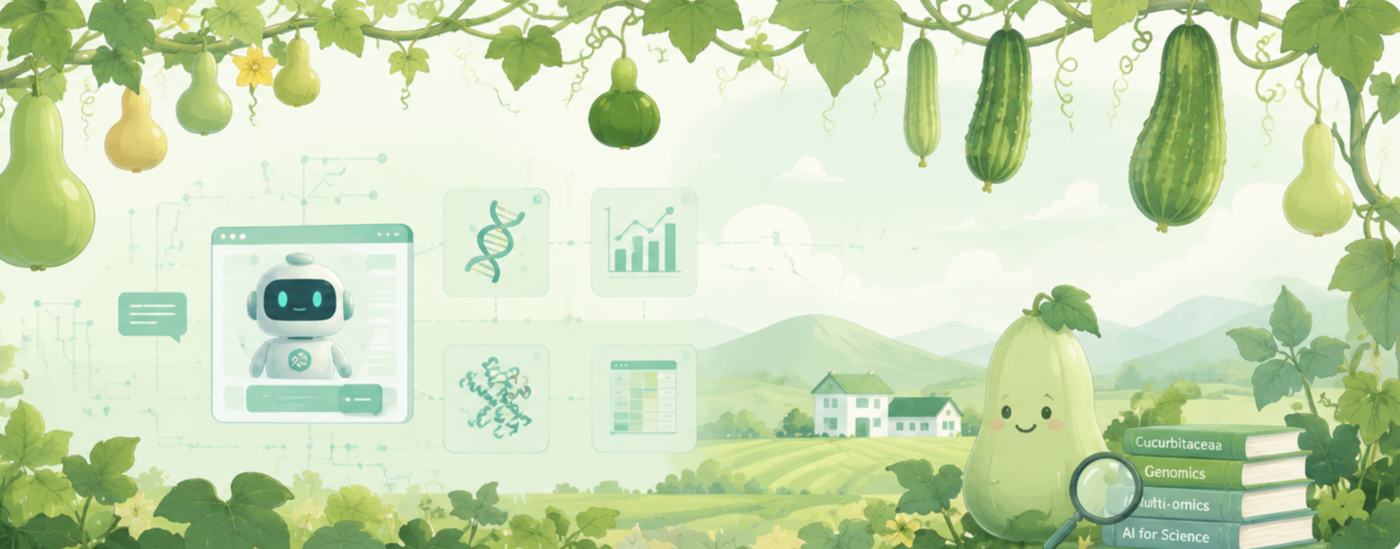
CucurbitAgent について
ウリ科作物——スイカ、キュウリ、メロン、カボチャ、ニガウリなど——は世界で重要な作物です。ゲノムデータセットと発表済みの研究は、遺伝子機能の理解と作物形質の改良に有益な情報を提供します。しかしこれらのリソースはデータベースや形式に分散しており、遺伝子識別子はゲノムバージョンによって異なることがあります。研究者は、一つの遺伝子をその発現パターン、遺伝的変異、予測タンパク質構造、発表済みの知見と結びつけるために、複数の情報源を参照する必要がしばしばあります。
CucurbitAgent は、北京市農林科学院(BAAFS)北京野菜研究センター(BVRC)によって開発され、9つの栽培ウリ科作物のマルチオミクスリソースを統合しています。プラットフォームは、遺伝子アノテーションと候補ホモログ、バージョン間遺伝子IDマッピング、自然遺伝変異、組織発現プロファイルと共発現関係、ESMFold によるタンパク質構造予測、GPSite による結合部位予測、および厳選された文献コーパスを統合しています。
ユーザーは自然言語で質問することでこれらのリソースを探索できます。会話型 AI エージェントが適切なツールを選択し、基盤データベースから情報を取得して、出典記録にリンクされた回答として統合します。研究者は「遺伝子」「発現」「タンパク質」「文献」モジュールを直接利用して検索し、利用可能なゲノムリソースをダウンロードすることもできます。
これらの相補的な証拠源を結びつけることで、CucurbitAgent は、研究者が候補遺伝子を調査し、発現パターンを解釈し、配列と構造の文脈で変異を検討し、機能研究と作物改良のための仮説を構築することを支援します。
最新文献
(2026-11-02)The clinical application of camptothecin (CPT) is limited by poor solubility and severe toxicity. This study compares the therapeutic performance of a cucurbit[7]uril-based CPT complex (CB[7]-CPT) with free CPT and β-cyclodextrin-CPT (β-CD-CPT) in colorectal cancer models. In vitro, free CPT, β-CD-CPT, and CB[7]-CPT were tested on normal LO2 and cancerous HCT116 cells. CB[7] encapsulation reduced toxicity toward normal LO2 cells (IC50: 0.47 μM, ∼25-fold higher than the IC50 of free CPT) while improving potency against HCT116 cells (CB[7]-CPT IC50: 0.24 μM; free CPT IC50: 0.55 μM, ∼2-fold more potent than free CPT). The selectivity index improved from 0.034 (CPT) to 1.976 (CB[7]-CPT), indicating a wide safety margin. Apoptosis assays confirmed that CB[7]-CPT induced significantly greater apoptotic cell death at equivalent concentrations than either free CPT or β-CD-CPT. In HCT116 xenograft models, CB[7]-CPT achieved a tumor inhibition rate of 76%, markedly outperforming free CPT (46%) and β-CD-CPT (62%). This enhanced efficacy was accompanied by increased intratumoral apoptosis, reduced proliferation, and decreased microvessel density. Importantly, CB[7]-CPT markedly attenuated liver, kidney, and gastrointestinal toxicity typically associated with CPT exposure. Pharmacokinetically, CB[7]-CPT displayed a 1.94-fold higher AUC and a 1.59-fold prolonged elimination half-life relative to free CPT, reflecting extended circulation and improved systemic exposure. These findings collectively establish CB[7]-CPT as a highly effective and safer alternative not only to free CPT but also to conventional cyclodextrin-based formulations, demonstrating enhanced selectivity, robust pro-apoptotic activity, and a superior safety profile.
The melon fly, Zeugodacus cucurbitae (Coquillett), is a major pest of cucurbitaceous fruits, and insecticides are widely used for its management. However, sometimes environmental factors may reduce insecticide deposits below lethal levels, and adult flies may receive only partial exposure during spraying, resulting in exposure to non-lethal doses. This study evaluated the reproductive fitness of Z. cucurbitae survivors following LD20 exposure to commercially available formulations of fipronil, spinosad, and malathion. Adult flies surviving topical LD20 treatment were assigned to 4 treatment combinations: (1) treated female and treated male (F+M+), (2) treated female and untreated male (F+M-), (3) untreated female and treated male (F-M+), and (4) untreated female and untreated male (F-M-). Malathion (0.18 μg/fly) exerted the most pronounced effects on Z. cucurbitae, significantly reducing mating frequency, progeny production, and adult longevity of treated flies, while increasing the proportion of malformed offspring. In contrast, fipronil (0.04 μg/fly) and spinosad (0.005 μg/fly) exhibited significant effects only when both sexes were treated. Notably, LD20 treatment with malathion enhanced the mating competitiveness of treated female flies, indicating a potential stimulatory effect. The findings suggest that LD20 of malathion had a significant impact on the reproductive fitness of melon flies, even when only 1 of the sexes was treated. In contrast, spinosad and fipronil produced adverse effects only when both sexes were treated, with minimal effects observed when only 1 sex was treated.
🔗 外部リソース
引用
本プラットフォームが研究に役立った場合は、以下を引用してください:
CucurbitAgent: An AI agent for exploring cucurbit multi-omics resources. Rong Zhang, Jian Zhang, Yuming Zhang, et al. bioRxiv 2026.10.09.758138; doi: https://doi.org/10.64898/2026.10.09.758138